So, a perfectly normal human’s brain, body, and reproductive system can have different sexes.
Biological differences: There are 6 normal karyotypes – XY, XX, X, XXY, XYY, XXXY. All of these are categorized into Visual Differences of Sex Development (VDSD) & Non-Visual Differences of Sex Development (Non-VDSD).
Gender Identity(GI): It is the psychological sense of oneself as a male, female, gender-fluid or agender. Neurobiological studies of gender identity suggest, so far, that this can be the result of some hormonal activities at the prenatal phase which again is perfectly normal. The above-mentioned terms are umbrella terms that include around 30 different types of identities (as I know of, for now, but can be more) like androgynes, aporagenders, bigenders(2 Spiriteds), genderqueers, gender creatives, or Cisgenders like me.
Gender Expression(GE): It is how someone expresses oneself outwardly irrespective of their sex or GI. They can be masculine, feminine, androgynous or more. For example, a Butch is someone who identifies herself as a female but expresses masculine features and a Femme is someone whose GI and GE are both feminines.
Now about Trans: It is an umbrella term used to describe a wide range of people whose GI and GE differs from their biologically assigned sex. A trans woman is a woman and a trans man is a man irrespective of their decisions to undergo surgery.
Sexual orientation(SO), Sexuality(Se) & Romantic Orientation(RO): SO is your preference for intimacy based on the GI or GE of the opposite person. You can be heterosexual, homosexual, bisexual, pansexual, or Asexual.
“Se” is how you identify yourself sexually. Based on that you can be Androsexual, Gynosexual, Autosexual, Allosexual, Graysexual(umbrella), Demisexual, Fraysexual, Sapiosexual, Skoliosexual, Multi, Pan, or Omnisexual(+).
RO is how you are romantically involved within a relationship and what your emotional drives are. Your SO may or may not coincide with your RO. Based on this you can be Demiromantic, Autoromantic, Frayromantic, Aromantic, or more.
Gender Congruence: This is an ongoing process of a common desire for many. It is the feeling of harmony in our body, experiencing the comfort after naming our gender that adequately corresponds with our internal sense of who we are.
How to be respectful(in general)?: Start by asking the people you interact with, for their pronouns(not gender) before beginning any conversations. Use appropriate words, like some people prefer to use “erectile tissue” rather than “Penis” & “internal genitals” rather than “vagina”. Do not misuse your privileges. Start referring to” transitioning people” as “people pursuing congruence”. Change your terminology from ” sex reassignment surgeries” to “sex affirming surgeries”. Stop asking Trans people their deadnames, that’s disrespectful. They haven’t gone through hell just to be kept reminded of their past. Respect everyone’s privacy.
How to be an ally?: Ally is any Cis person who supports Trans-identities, challenges Transphobia, and willingly explores these biases within themselves. So, to be an ally, you have to stay updated with the evolving terms, be respectful (ref: above), introduce yourself along with your pronouns, use inclusive tones while initiating a conversation, avoid & challenge ignorant compliments like ” you are too pretty/handsome to be a trans.” Know your limits. The most important one is to accept your mistakes and learn from them. You are a human too.
So, here’s an XX-Cis (She/Her)-Hetero-Demisexual-Demiromantic-Gender congruent-Ally saying “Hello” to you.
Have a good day!
Here are a few links to the sources which can be used for further references.
“Data is a precious thing and will last longer than the systems themselves.”
– Tim Berners-Lee, Inventor of the World Wide Web
Every circadian human activity generates an enormous amount of data into the chain. There has been an exponential growth in data in the last 3 years than in the past 100 years. The universe of data is predicted to grow from a mere 4.5 zettabytes to reach 165 zettabytes by 2030 creating a plethora of hidden potential in this upsurging cloud and it needs to be effectively mined to extract valuable insights.
Data Mining, a term used to sift through the troves of data to unearth useful nuggets of information that enables businesses and the general mankind to make better decisions. Data is futile without being mined and information is futile without being actionable and of business or real-life value. So how do we get from the data to insights to actions and thereby to a more data-driven future?
The prognosis for this ever-expanding data is to come up with not one but a set of powerful tools/toolkit to merge, analyze and visualize a vast amount of structured and unstructured data in a very short amount of time. This requires a powerful set of algorithms that includes AI, Machine Learning, and in some cases, Deep Learning, a strong set of natural language processing engines, and advanced graph computation, all based on distributed in-memory processing and versatile data ingestion capability from pre-built and custom data feeds.
A combination of the above, and with some humans-in-the-loop, data analytics can take a form of an Oracle with predictive and scenario generating capabilities.
Understanding Predictive Analysis :
Predictive analysis is the branch of advanced analytics that makes use of data mining, predictive modeling, machine learning, and artificial intelligence to bring together the management, information technology, and modeling business strategies to make future predictions. Data mining, text analytics, and statistics together allow users to establish predictive intelligence by uncovering patterns and relationships between the pre-existing structured data and newly fed raw and unstructured ones.
Hence, the goal is to identify the historical patterns, analyze the occurrences, and predict the future to assure a systematized environment that’s both consumer-friendly as well as beneficial to the innovators.
History of analytics :
Statistical data presentation and use of the same is not a new concept. Historians indicate that ancient Egyptians used statistical records for building pyramids. This is the same with the south Indian temple architecture or any geometrically designed religious places where analyses were based on the type of deity it is built for along with the cardinal point calculations and bent of human populations.
Analytics, or as we call it today, Data Analytics has been surviving simultaneously with us for quite some time now. The use of this powerful insight tool can be traced back to the 19th century when Frederick Winslow Taylor initiated time machine exercises or when Henry Ford measured the speed of assembly lines. Before the development of computers, US census reports would take seven years to collect, process, and generate the final report. Herman Hollerith in 1890 developed a tabulating machine that would systematically process recorded data. This device helped to complete the report in 18 months. In the late 1960s, analytics began receiving more attention when computers started serving as the major decision-making support systems. Relational Databases invented by Edgar F Codd in the 1970s, became quite popular for they allowed users to write in the Machine-understandable language called SQL by providing the advantage of data analysis on demand. But the dark side to this was the rigidness of RDBs that was not designed for unstructured data. This led to the invention of non-relational databases. By the late 1990s, the enormous flow of divergent information made working with RDBs hectic, and non-relational databases or No-SQL replaced the rigidity of SQL with smoother performance. With the growing vogue of the internet and the development of the google search engine, analytics started gaining more popularity. With the expansion of concepts like Big data, Data warehousing, the advent of the cloud, and a variety of software and hardware, Data analytics underwent a significant evolution.
“There were 5 exabytes of information created between the dawn of civilization through 2003, but that much information is now created every 2 days.”
– By Eric Schmidt, Executive Chairman of Google
Note: The disparate nature of data like images, blobs of text from conversations, chats, videos, and all kinds of multimedia only amplified with the emergence of social media, the democratization of both content consumption and creation.
Predictive analytics, an advanced form of data analytics answers the most crucial question in any mushrooming field, “ what will happen next?”.
The Predictive analytics probability models trigger from historical data, sensor data, and data-in-event evaluating specific consumer behavior and fed or unexpected global information generating a prediction within milliseconds empowering the institution implementing Predictive analytics for a market study aiming at exponential growth.
So what are the advantages now that will add to the use of predictive analysis?
Upsurging amount of data every second and diversity of data being generated.
Faster, reasonable, and better-refined computers.
Easy handling software
Tougher economic conditions and a need for competitive differentiation
How does Predictive analytics work? :
Predictive analytics has been increasingly used in many institutions as AI-powered analytics, delivers scalable logic and data visualization protocol that facilitates various organizations to design, deploy, manage, and secure reports spawned from various data sources. Here is a step-by-step process of how predictive institutionalized.
Project Definition :
Defining the project upshots, deliverables, spectra, goals, identifying the data sets which are going to be used make the core of this process.
Data acquisition:
Data acquisition, or DAQ as it is often referred to, is the process of digitizing data from the world around us so it can be displayed, analyzed, and stored in a computer. A site example is a process of measuring the temperature in a room as a digital value using a sensor such as a thermocouple. Modern data acquisition systems can include the addition of data analysis and reporting software, network connectivity, and remote control and monitoring options.
Data Mining :
Data mining involves accumulating, scrutinizing, and evaluating large blocks of information from various advents to glean meaningful patterns and trends.
Data Analysis :
Further, the data is analyzed, scoured, transformed, and sported to discover if it provides useful information and helps to infer.
Statistics :
This facilitates to substantiate if the outcomes, inferences, and speculations are admirable enough to go ahead and assess them using a statistical model.
Predictive Modeling:
It procures the ability to automatically build precise predictive prototypes about the future. There are also alternatives to choose the best solution with multi-model evaluation.
Predictive Model Deployment :
This provides the option to deploy the analytic results into the everyday decision-making techniques to get results, dissertations, and output by automating the conclusions based on the modeling.
Model Monitoring :
Models prepared are further tracked to regulate and check for performance congruence to ensure that the desired outcomes are amassed as anticipated.
Busting myths about Predictive analytics:
Predictive analytics are used to discern customer responses or investments, as well as promote cross-sell opportunities. These models help businesses entice, retain and boost their most profitable customers.
But it also requires investment: in your data, in infrastructure and technology, and your time. And organizations’ decisions are too often clouded with misconceptions and myths that need to be busted. Here listed are a few fallacies and their answers.
#1 “To deploy artificial intelligence, we have to invest a lot in exotic new hardware and dedicated infrastructure.”
This myth was true a few years before. But now you can start on the pre-existing infrastructure you already have and surge from there. There’s no need to make vast up-front investments.
Three falling costs make data analytics more accessible in today’s market.
The cost of data repository –An Infoworld analysis of cloud storage prices found that Amazon AWS, Microsoft, Google, and IBM have lowered their cloud prices and it will keep coming down, thanks to Moore’s Law, H/W is getting cheaper and cheaper and most of the cloud services as pay-as-you-go models – so you don’t have to invest upfront. You do your data analyses and shut down your H/W until you need it again.
The cost of using data analytics software has come down. You no longer need to buy multiple software packages to achieve your goals. And if done well, could be free of cost with the open-source utilities democratized by big tech companies like Google, Facebook, Twitter, etc.
The ease of generating and consuming more data than ever before through mobile devices and Internet of Things (IoT) platforms.
Sum it up and you have an abundance of data to implement a well-planned data management technique at a much more reasonable price than ever before.
#2: “Predictive models take too long to build.”
Nope. The dawn of predictive modeling software has made the functions so incredibly efficient that most outcomes can turn out within seconds or minutes.
#3 “We don’t need advanced analytics like machine learning for our business.”
All enterprises need analytics, irrespective of their size. What’s crucial is comprehending the key business issues within your organization and analyzing how advanced analytics can help you unravel them.
#4: “Predictive models are a “black box” and can’t be validated.”
That depends on the type of institution. There are firms and counsels whose predictive models (built for their clients) fall into a “black box,” hampering the translucency of how the model was scored. But it is never the end of the world.
#5 “Data analytics is only for online companies.”
No, it’s not true as most of the frameworks to process, analyze data are based on the open stack – free for any use sans the copyright you can even build one tool yourself using some of these frameworks.
Companies like Domino’s have implemented analytics to focus on creating a trusted data foundation to support their marketing campaigns. It has transformed from a pizza restaurant to a technology company that sells pizza!
#6 “Predictive models replace human judgment.”
As much as we wish this was true, but no predictive models were ever implied to supersede the human judgment or intuition that adds to the process. The majority of the time, predictive modeling aims to enhance and broaden human aptitude in data analysis. After all, it takes a human to decide what datasets to consider and make smarter decisions.
Surpassing these myths, we can now move forward with a peek into the applications of Predictive analytics.
Applications of Predictive analysis :
Customer targeting: Dividing a customer base into groups of individuals similar in specific ways relevant to marketing, such as age, gender, interests, and spending habits enables companies to target tailored marketing messages accurately to customers who are most likely to buy their products.
Churn Prevention: By harnessing the power of big customer data sets, companies can develop predictive models that enable proactive intervention. These companies then interpret the causes of churn and take mandatory actions to retain those customers. For instance, by offering the customer a discount or an extra feature.
Cross-Sell: Application of predictive analytics investigate customers consuming rate, usage, and other aspects, leading to efficient cross sales, or selling additional products to current customers for an organization that offers multiple products.
Risk management: Predictive analytics foresees the best portfolio to maximize return in the capital aid pricing model and probabilistic hazard assessment to yield accurate visions.
Underwriting: Predictive analytics can help underwrite the numbers by anticipating the odds of illness, defaults, and bankruptcy. It can facilitate the technique of customer accession by predicting the future risk behavior of a customer using application-level data.
Financial modeling: This is done by deciphering a set of hypotheses about market behavior or envoys into numerical forecasts. These predictive models are used for benefiting the firms in decision-making procedures about investments or recoveries.
Health Care: The application of predictive analytics in the healthcare sector can infer the patients who are at the risk of developing specific ailments such as diabetes, asthma, and other lifetime illnesses. The clinical decision support systems integrate predictive analytics to benefit decision-making making at the point of care.
Fraud detection: Predictive analytics applications can find erroneous credit applications, defrauding trades both done offline and online, identity thefts, false insurance claims, Pandemic prevention, or Voter Swing Prediction (for elections).
Summary and takeaways:
Predictive analytics and machine learning are often confused with each other but they are different disciplines.
Predictive analytics extracts information from data sets to uncover alliances, recognize patterns, predict manias, discover coalitions, etc.
It allows enterprises to foresee the future and make ethical verdicts.
The applications of predictive analytics in business intelligence can be inexplicable yet play a key role in attaining impressive goals.
These can be used across many initiatives and are a great way to boost the outcomes and predict future events to act accordingly.
Methods of predictive analysis applied to customer data can establish a holistic view of the customer.
Proper application of predictive analytics can lead to more proactive and effective retention strategies.
“Everything is going to be connected to cloud and data… All of this will be mediated by software.”
“The nationalist search for the identity of a community is often preceded by a construction of knowledge and consciousness of that identity.”
Before deciphering the actual essence of Six acres and a third by Fakir Mohan Senapati, I will try to present a brief scenario of Odisha before the British colonization.
History:
With the decline of the Mughal administration in India, Odisha came under the control of 2 extreme powers – the Nizams of Bengal and the Bhonsles of Nagpur. Where on one side the Maratha Marauders, having no intention of staying in Odisha, made it their exile land, the Nizams started sub-colonizing parts of Odisha. There was a phase in history when Odia was about to get registered as one of the dialects of Bengali. And then started the famous event of English Colonization in Odisha.
Feudalism in Odisha:
“the insertion of India into colonialism is generally defined as a change from semi-feudalism into capitalist subjection”
Pre-Colonial Feudal System in India
Feudalism in India was characterized by a class of landlords and by a class of subject peasantry, both living in a predominantly agrarian economy marked by a decline in trade and urbanism and by a drastic reduction in metal currency. Interestingly, these zamindars plotted day and night to devour the helpless peasants and they succeeded in their devious schemes. They are the bourgeois who grew huge by looting the proletarians out of their physical strength and property. But what happens ultimately is that these zamindars got trapped unexpectedly by a superior force, The English, men who flew swiftly and robbed the toil of their whole life. The English entered just to trade but finally mastered encroaching upon all the riches of the colony. Not only the colonizers from the outer world but also the insiders, like the Brahmins, fed from the pond. The Brahmins without doing any physical endeavor acquired a great deal of property by simply blessing the Maratha Subedars. When the political and economical conditions in Odisha are analyzed, it is clear that British rule came as a liberating force for many. The Indians welcomed the British rule to free themselves from their previous colonizers, the Brahmins, the Marathas, and the Mughals. It became a metaphysical compulsion for the natives to await and to accept a better superior force.
Fakir Mohan Senapati and Colonization of Odisha:
Utkala Vyasa Kabi Fakir Mohan Senapati
Six Acres and a Third novel was conceived as an answer to a social need and the needs of a specific mode of production. While Fakirmohan, trying to locate the ultimate cause of such a process, transcends history and time to speculate on human nature and the workings of fate, his immediate interest concerned the fifty years of political instability. The circumstances under which colonialism came to Odisha were peculiar. The British did not grab power from the hands of the indigenous rulers of Odisha. For a long time, the center of power that ruled Odisha was outside Odisha, either at Nagpur or at Murshidabad, and in many circles, the coming of the British was perceived as deliverance from misrule. The insidiousness of the colonial structures of power and culture could not be perceived by the common folk who had already been reeling under oppressive and exploitative systems of rule for quite some time.
The reaction of a native in Six Acres and a Third sums up the mood of the people:
“Oh, horse, what difference does it make to you if you are stolen by a thief? You do not get much to eat here; you will not get much to eat there. No matter who becomes the next master, we will remain his slaves. We must look after our own interests” (205-206).
Six Acres and a Third record the political and the economic situation immediately after the occupation of the coastal districts of Odisha by the British East India Company. It highlights the consequences of the greed of the British rulers and their attempt to impose an alien economic and land revenue system. On the one hand, the British saved the common people from the violence and extortion of Maratha marauders, but, on the other, they ruined the traditional society in such a manner that the common people were disinherited from all their traditional occupations and professions. They were tied down to just one profession, i.e., agriculture. Soon, they were even disinherited from their lands by the Bengali sub-colonizers and were reduced to the status of farmhands. While the people in common were losing the moorings in their own land, a new privileged class got consolidated. This new feudal class consisted of the Bengali officers of the Company, the landlords from Bengal, and the few manipulative Odias who used their access to British education and their proximity to power to rise economically and socially. These neo-feudal were aping their colonial masters and were much more oppressive towards the common people, at whose cost they had risen socially.
Tragedy in Satire: Six Acres and A Third:
The dehumanizing effect of colonialism can be seen in the figures of Ramachandra Mangaraj, the protagonist of Six Acres and a Third. Mangaraj’s rise and fall can only be visualized in a colonial setup. By leveling traditional hierarchies and discrediting social norms, colonialism had spawned unnatural ambitions and easy means of fulfilling them. In the absence of the social safety valves that are available in a traditional society, Mangaraj spends his childhood in a state of uncertainty and deprivation. In the absence of traditional social and moral reprimands, he uninhibitedly pursues his design of upward mobility through unworthy means.
Mangaraj manipulates the loopholes in the colonial legal system quite easily and establishes himself within a new feudal order where wealth and proximity to the rulers were the only qualifications for prominence. Mangaraj pays for his unnatural ambition and upward mobility through his alienation from the community. The signs of his dehumanization can be seen in the ruination of his family and the way he has turned his house into a virtual brothel:
“Like birds of different feathers seeking shelter in a large tree, [women] had flocked to Mangaraj’s house. They kept arriving and leaving; it was impossible to keep track of their movements” (54).
Mangaraj’s monomania for property not only transforms him into a commodity but also dehumanizes the entire world around him. Fakir Mohan seems to ascertain that not only greed but also the pursuit of wealth too could cause dehumanization. The colonial economic instrument is in this sense doubly corrosive: while allowing a few to arrogate power unto them and to enrich themselves disproportionately, it plunges the majority into a state of penury and disempowerment. Extreme poverty and disempowered, Fakirmohan rightly visualized, could be a source of moral degeneration and dehumanization.
For all its comic vitality, Chha Mana Atha Guntha is a poignantly tragic novel. Senapati’s world, that of nineteenth-century Odia society, had been transformed beyond recognition by the utilitarian ideas imported through “enlightened” British civil servants. A predominantly communal-rural-oral life started disintegrating under the pressure of a body of written laws and the alien values of English education. To the British, this form of life had come to represent an anachronism, a crude form of socialism, paralyzing the growth of individual energies and all their consequences. The continuation of such a state of society, they felt, was “radically inconsistent with our rule both in theory and practice.” Chha Mana Atha Guntha can be read as a passionate and moving rejoinder to the attitudes and programs of action enshrined in these remarks. For its characters, paralyzed by the “flood-like onrush” of English civilization, the utilitarian agenda practically meant the harsh imposition of unfeeling authority.
The action of the novel concerns a series of displacements affecting owners of the land, with the nature of ownership subjected to constant definition and redefinition. To take the one central example of the zamindari of Fatepur Sarasandha, we note that it was initially in the hands of the traditional Odia military aristocracy. Senapati uses Sanskritized Oriya, a kind of Latinate diction, in describing them, thereby establishing the link between language and a way of life. This aristocracy loses its title to the land because it fails to cope with the new utilitarian dispensation which renders its benevolent paternalism and belief in personal valor obsolete. Over time, the zamindari passes into the hands of a Muslim trader (the ruling language is now Persian), who had bought it at an auction in Calcutta. This estate is then seen passing to an upstart Odia moneylender (the protagonist of the novel). In trying to defraud a poor weaver couple of a small parcel of land, (six acres and thirty-two decimals, to be precise), this moneylender-cum-zamindar gets into trouble with the law and loses his estate to his English-educated urban lawyer.
Faced with the law-enforcing agents of a colonial state (who take down every word that is uttered), the villagers of Gobindpur lapse into incoherence and silence. These are the same people who had a little while ago shown such remarkable resilience, pluck, and resourcefulness when they made the story of Mangaraja’s crime circulate with alightning-like rapidity through the word of mouth. The very same people cower in fear because their depositions are “pen-imprisoned” or “Kalambandh” by the investigating officer. Writing is a source of power for those like Mangaraja, the protagonist of the novel, who can effectively control it. Mangaraja can dispose of the weaver couple through, among other things, his control over the written word. In the end, however, he loses out to an even more coherent, English-speaking/writing urban lawyer (Ram Ram Lala), a more finished product of the colonial/utilitarian order, who might be compared with Bitzer of Hard Times by Dickens. The shift from Mangaraja’s Oriya to Ram Ram Lala’s legal English denotes a transition from country to the city.
Chha Manna Atha Guntha is not, however, only an elegy on the gradual disappearance of a communal-rural-oral tradition. It also vigorously mobilizes resistance to the fact-based, rational order by raiding the resources of the same tradition.
On the day of the trial of Mangaraja, everything in the courtroom has been “Englished”, as the novelist archly remarks. English law, in this instance, has turned English, thereby completing the alienation of the native Odias from a legal system designed to give justice to the individual members of an open, competitive society. Even the novelist is obliged to step into the role of a translator here, for the court proceedings on this day are conducted entirely in the English language in deference to the British civil surgeon who is present in the courtroom to give his testimony. Thus, the entire trial becomes an awesome display of colonial might, aimed at intimidating the native witnesses into submission. Mr. H.R. Jackson, the white judge, at one point, threatens the Oriya defense lawyer with the cancellation of his lawyer’s license if the latter does not come to the point. Coming to the point, itself a thoroughly utilitarian prescription, means, in this instance, an unquestioned and unreserved acceptance of the authority of the British civil surgeon, A.B.C.D. Douglas (the son of, as the novelist playfully remarks, E.F.G.H. Douglas). The irreverent wordplay on the English name here is part of Senapati’s wider purpose to defeat the language of power by the power of language. Senapati’s language derives much of its power from its allusive and allegorical qualities, the two main attributes of a rich and vibrant oral tradition.
Conclusion:
Senapati’s novel is a realistic portrayal of colonial rule. He balances the two realities of the Western Empire. The British colonial one on the one hand oppressed, enslaved, and exploited but on the other hand, it helped. Senapati says, “Today in the nineteenth century the sciences enjoy great prestige, for they form the basis of all progress. See, the British are white-skinned, whereas Odias are dark in complexion. This is because the former have studied the sciences, whereas the latter does not know of these”.
British shaped India through its scientific inventions, a form of government and enlightened many people. It was the missionaries who liberated the native people from their superstitious beliefs and provided education to the downtrodden natives. This is visible in the words of Senapati, “Ask a new babu his grandfather’s father’s name and he will hem and haw, but the names of the ancestors of England’s Charles the Third will readily roll off his tongue”. The British colonial rule was truly helping India by educating the lowly and deprived society. The downtrodden, illiterate people now became ‘babus’ because they have mastered knowledge from their colonial masters. In other words, the natives were assimilated into the colonizers’ culture. The narrator is highly ironic in his words in conveying the realities.
Senapati’s every move in the novel is a critique of colonial rule. Every minute detail mirrors the consequentialism of British colonial rule in India.
(We already have the answer to this, but here’s more.)
Now to draw your attention to something that has been growing right under our nose in society since the dawn of human civilization yet most of us weren’t aware of it, here I surface the information I gathered.
Khafz, Khatna, or circumcision isn’t something new. I always felt it was barbaric to cut the skin as useless as it might be but opposing it never went well(debatable topic). But what made me question humanity itself was the same thing happening to the other gender at an intensity beyond limits.
So here’s TW: Losing sanity or Trust in humanity.
“Haraam ki boti – The sinful clump of flesh”
FGM or Female Genital Mutilation is something I came to know about a month back. Talking about the procedure, they are of 4 types. Type 1 is where they partially or completely remove the clitoris (an organ whose central role is self-pleasure.) Type 2 is where again they partially or completely remove the clitoris, labia minora, and sometimes the labia majora. Type 3 involves the narrowing or sewing up of the Vaginal opening along with the Clitoris, Labia Minora, and Majora (called the infibulation). And Type 4 includes harmful procedures to the female genitalia for non-medical purposes, for example, pricking, piercing, incising, scraping, and cauterization.
Notes: 1)Deinfibulation is a surgical procedure carried out to re‐open the vaginal introitus of women living with type III female genital mutilation (FGM).
2) Reinfibulation is the procedure to narrow the vaginal opening in a woman after she has been deinfibulated (i.e. after childbirth); also known as re-suturing
So where all this started?
FGM in History:
Supposedly originated as a slave trade practice, the history of FGM leads us back to ancient Egypt where infibulated mummies were found. The practice was also implemented on female slaves in Ancient Rome, deterring recipients from coitus and subsequent pregnancy. With its widespread prevalence, a “multi-source origin” has also been proposed, claiming that FGM spread from “original cores” by merging with pre-existing initiation rituals for men and women. It is also believed that this might be a process of population control among tribes and what started as just infibulation gradually took the shape of clitoridectomy. (Not in support of either of them.)
Present-day Kenya has a history of performing a traditional act called “The Irua” of both boys and girls. It is Type 2 FGM and the girls who have not gone through this process are called Irugu and are outcasted.
Idea Behind FGM/C:
You might have guessed by now, this practice was clearly to support the patriarchy. To conserve females as marriageable properties, to ban them from indulging in adultery, to prevent them from self-pleasure activities, the process involves the chop-chop of the organ that helps in incitation and female pleasure. This whole idea is revolving around the concept of female purity.
FGM in India:
As Samina Kanchawala, the Secretary of DBWRF said (& acc. to Da’im al-Islam), this is the act of Taharat which forms the root of Islam (nowhere mentioned in Quran though). According to her, this process includes putting “just a nick” in the hood (which acc. to her is okay) that allows women to stay sane and surrender themselves to religious activities. Ugh!
Syedna Mufaddal Saifuddin, the spiritual leader of the Dawoodi Bohra, stated in 2016: “Religious books, written over a thousand years ago, specify the requirements for both males and females as acts of religious purity.”
So, yes “Female Genital Mutilation” is also happening in India in the Dawoodi Bohra community (ostensively one of the most educated Muslim communities), in Maharashtra, other Bohra sects including the Sulemani Bohras and the Alavi Bohras, as well as in some Sunni communities in Kerala. The Bohras are primarily traders and businessmen. In ancient times, when the men would travel to other countries, women of the house would stay behind. So to prevent these women from getting into any kind of adultery, to follow bogus traditions & to curb a girl’s sexuality, FGM was being carried out.
Barbarism Alert! :
I request you to listen to Khadija Gabla’s TedX talk to understand the intensity of female genital mutilation in the rest of the world.
On interviewing a few women from the Bohra Community, this horrible side of woman society came forward. On contrary to what the position holders say, all the victims of FGM in India had similar stories to share.
(The girls of age 7 to 16 are mostly the victims of FGM). Their mother allures them to buy gifts and chocolates and take them to a dingy place (allegedly in Bheendi Bazaar). An old woman, that resembles the description of a “Dai Maa” or a midwife, prepares the set by heating the blade on a stove or a lamp. The girl is then pinned down on a flat surface, and Dai cuts the part with the heated blade in no time. And the girl is left with excruciating pain for a long time. The circumcisers or midwives are generally older women who perform the act with or without anesthesia. But in communities where the male barber has assumed the role of health worker he will perform FGM too.
Did you notice something? There aren’t many men involved in the entire process. A clear case of “a woman can be a woman’s direst enemy”, all the cases involved the mother taking her little girl to perform such an act. And I don’t even blame them completely for they are the victims themselves without even realizing it.
Effects of FGM in Women: Health complications:
By far there have been no reported health benefits of FGM (though a few supporters claim it to be a part of female hygiene). Most of the cases reported had long-term health hazards.
Immediate complications can include severe pain, hemorrhage, genital tissue swelling, fever, trauma, or tetanus.
The long-term complications include painful urination, bacterial vaginosis, painful menstruations, Dyspareunia or painful intercourse, and painful delivery.
Legal Proceedings and campaigns:
(Female Genital Mutilation has been recognized as an act against Humanity by both UNICEF and WHO.)
The world’s first known campaign against FGM was carried out in 1920 in Egypt.
The Egyptian government banned infibulation in 1959 but allowed partial clitoridectomy if parents requested it. By 2007, Egypt had completely banned FGM followed by Australia, Iran, Iraq. Kenya had specific laws against FGM in 2001, New Zealand and Norway in 1995, South Africa in 2003, and the UK in 1985.
November 2011, the first online petition against Khafz was filed by Bohra women.
In February 2016, two NGOs “Sahiyo” and “We Speak Out” launched a campaign against FGM called “Each One Reach One”.
By 10th December 2016, a group of Bohra women submitted a petition against FGM in India to India’s Women and Child Development Minister Maneka Gandhi. By May 2017, Maneka Gandhi announced to take the necessary steps to stop FGM in India. In September 2017, for the first time “FGM in India” issue was presented at the United Nations Human Rights Council. But in December 2017, the Ministry of Women and Child Development(India) reported zero official data on FGM in India.
In November 2019, SCI announced that FGM is a seminal issue and to be discussed alongside other women’s issues. As of now, there are no specific laws against FGM in India. It apparently is generally criminalized by the 1860 Indian Penal Code, 1973 Criminal Procedure Code, and 2012 POCSO Act (But no specific laws).
The Silver Lining:
1. In 2012, the UN General Assembly designated February 6th as the International Day of Zero Tolerance for Female Genital Mutilation, to amplify and direct the efforts on the elimination of this practice.
2. Since the UNICEF/UNFPA program was established in 2008, 13 countries have passed national legislation banning FGM.
3. In 1997, WHO issued a joint statement against the practice of FGM together with the United Nations Children’s Fund (UNICEF) and the United Nations Population Fund (UNFPA).
4. In 2018, WHO launched a clinical handbook on FGM to improve the knowledge, attitudes, and skills of health care providers in preventing and managing the complications of FGM.
5.Organizations like EndFGM, We Speak Out and Sahiyo are aimed at irradiating FGM for good by reaching out to people, educating the mass and standing against this brutal belief.
Art, Literature, and FGM:
1. FORWARD(Artists Unite to End FGM) is a network of socially conscious artists committed to ending female genital mutilation (FGM), child marriage, and all violence against African women and girls.
2. Yasser Nazmy, a UI/UX Designer, designed a set of posters on traditional FGM as a part of his GD project.
3. Shinaakht is a short film, starring Raju Kher, based on Circumcision which challenges Male Gentile Mutilation (MGM) and Female Gentile Mutilation (FGM) as per Islamic Law.
4. Other movies like Jaha’s Promise, Dunia, and Desert Flower are based on female genital mutilation spread around the world and women fighting against it.
5. Here is a set of books that are based on Female Genital Mutilation, its history, and ongoing struggles.
*Among the Maasai: a Memoir – Author: Juliet Cutler
* Saving Safa: Rescuing A Little Girl from FGM – Author: Waris Dirie
*Cut Flowers – Author: Aneeta Prem
*Do They Hear You When You Cry – Author: Fauziya Kassindja
*Desert Flower by Waris Dirie
*Infidel by Ayaan Hirsi Ali
Conclusion:
There isn’t any yet. It’s an ongoing fight against the brutal tradition. And we have not yet arrived at any conclusions. But I hope to find words, someday, to conjure up into a beautiful sentence that says, “We(together) terminated this vicious act for good”.
Added here a set of links that would help you get clean facts about FGM. Feel free to discuss it anytime.
Every morning, waking up, grabbing a cup of tea, scrolling through the pages & ignoring the news feed that Google suggests was a routine for me. My Google feed was a collage of random tiktoker getting roasted, people traveling to places, new books in the market, mob lynching, random couple getting married lavishly, media vs Kunal Kamra, more lynching, fools blabbering “my horse is better than your horse” & all such ignorable stuff which used to give me panic attacks and ruin my mood at wrong times for no reason at all. A basic start to my day.
Ooo! That’s fascinating. I read two, just two more articles on the same issue that day. And it spoiled my life! The next day when I was just following my routine when I found that Google was a different person now ( ya person, you know what I mean). It no longer entertained me with shitty political news or media going “matlab kuch bhi” (Whatever!).
My “Aam Zindagi” turned into “Mentos Zindagi”. (Indian add Tag)
Google now splashes Big Data, analytics, or AI news on my face, like, boom! go watch how “Process Mining is empowering businesses”, or hey girl, see how ” SophiA Genetics uses AI for genome analysis” or wait! See, the food you eat is being prepared under strong AI surveillance. Trust me I tried to ignore every bit of it. But then came the monster that possessed me and demolished my faith, “How Instagram uses AI and Big Data for its algo-game “.
I dropped my weapons. I am done.
Now every day, I scroll through G-feed, saturated with new ideas, produce better and diverse content in a more structured way, without having bizarre chatters going on in my head.
You ruined my collage feed, Mr. S . See, how clever these AI people are. Let me show you a glimpse of my google feed.
Search engines use artificial intelligence (AI) to improve their ranking algorithms.
To get a little more technical, this particular area of artificial intelligence incorporates learning to rank algorithms. Machines are developed to create an optimal list from a set of possible outcomes, learning from each of the variables over time. People into SEO content writing will get this. (For freshers, kindly check the link). The companies hiring content creators look for Strategic SEO writers who furthermore have a hand in the content management systems (CMS) and are versed in MetaData. It’s pretty simple. Search engines are meant to find users what they’re looking for. With Machine Learning , it will get to the point where they will find exactly that and keep on suggesting relevant topics. So, your feed shows you exactly what you are looking for. It filters, categorizes, and whangs everything according to the type of data you feed it. To provide the best search result and understand the large data, the developers at the tech giant leverages natural language processing techniques (NLP) that helps in mapping the search to one specific set of the billions of data points in Data Commons to provide the right statistics in a visual as well as easy to understand format.
To summarize this we can say that Google uses AI to understand the people, places, and things involved in a story as it evolves, organize them based on how they relate to one another. We are already familiar with google assistance. So brace yourself when google comes with the fact-check techniques using the uploaded pictures or presenting you the song you hummed in the search by tracking its melody.
Before signing off, I would suggest fellow content creators and others who might be interested to “google” Bidirectional Encoder Representations from Transformers ( BERT ) and thank me later. Till then, I will go back to see what’s up with Neil Patel.
The Vietnam war isn’t something new to me, but I needed a reason to talk about it. Since we are doing this to #stopasianhate , I wouldn’t miss this perfect opportunity to explain it. Read The Mountains Sing for #readingasiapacific that covers a vast timeline. I will part it into two,
Part I : The Vietnam colonialism and wartime and Part II: My take on the book.
Part I: The Vietnam War. Timeline: 1940 – 1975
The Viet Nam War
Type:Conflict between Communist North Viet Nam and South Viet Nam plus allies.
Roots:French colonialism has been ruling since the 19th century. And during WWII, the Japanese invaded Viet Nam. Ho Chi Minh(Born as Nguyen Sinh Cung) was expelled for protesting against Emperor Bao Dai and French rule in Indochina. Inspired by Vladimir Lenin’s Bolshevik Revolution and Soviet communism, he started recruiting members for the Indochinese Communist Party.
Viet Minh:When Germany defeated France in WWII(1940), Minh along with his allies formed Viet Minh or League for the Independence of Vietnam. This was the time when Vietnam was under the drastic effects of “The Great Hunger” or The Vietnam Famine whose direct factors were French colonization, WWII, and the ongoing Natural disasters. When Japanese forces withdrew from Vietnam, leaving the French-educated Emperor Bao Dai in control of an independent Vietnam, led by Vo Nguyen Giap, Viet Minh forces seized the northern city of Hanoi and declared a Democratic State of Vietnam (known commonly as North Vietnam, or the Democratic Republic of Vietnam) with Ho as president. In a vision of a Unified Vietnam but with their respective concepts, Ho and Bao stood against each other tearing the country into two parts, The Soviet Supported North Vietnam of Minh and the US-backed South Vietnam of Bao.
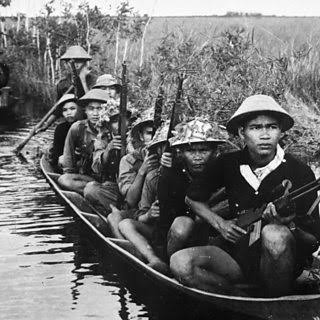
Viet Cong or NLF:National Liberation Front was the guerrilla force of South Vietnam that supported North communist Vietnam in the Tet Offensive. Any sympathizer of communist Vietnam was included in it and together was dubbed as Viet Cong.
Agent Orange:From 1961 to 1971, the US Army executed a herbicidal warfare program (along with the bombing campaigns) called the “Operation Ranch Hand” where military troops in aircraft drenched roads, rivers, canals, rice paddies, and farmland with powerful mixtures of harmful herbicides, called the agent orange that caused severe health issues. (Know more about Agent Orange here)
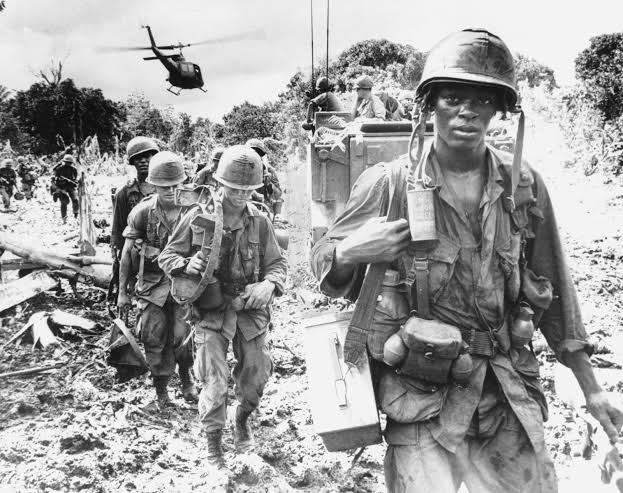
Tet Offensive: January 1968, a crusade of surprise attack was executed in 100 cities of South Vietnam by the NLF and PAVN army against the Army of the Republic of Vietnam (ARVN) and US troops leading to the Battle of Hue that resulted in one of the bloodiest Massacre of Vietnam, The Massacre of Hue that not only harmed the US soldiers but also the civilians. This created disbelief for the US govt among Americans and stunned by this, Republican Nixon called out for Vietnamization- a movement where the US troops were withdrawn from the site and the aerial and artillery bombardment were increased giving the South Vietnamese the training and weapons needed to effectively control the ground war.
My Lai Massacre:Then occurred the most shocking war crime of Viet Nam in march 1968, The My Lai Massacre. Unarmed men were slain, women were raped, mothers were shot, children were slaughtered and the village was burned down. This act was tried to cover up and took around 20 months to come into the light.
Leaving you to find out how the war ended and which side was primarily responsible for results, I will take the time to talk about the aftermaths,
The Post-War PTSD of the Veterans: In 1983, the National Vietnam Veterans Readjustment Study (NVVRS)1 was conducted by the U.S. government to better understand the development of PTSD from the Vietnam War, and the results were alarming. The reasons were War-Trauma, loss of near ones, friends from troops, self-medication during wartime, and misperception due to frequent failures. And most of these had long-term impacts.
What’s Left?: After years of warfare, an estimated 2 million Vietnamese were killed, while 3 million were wounded and another 12 million became refugees. Warfare had demolished the country’s infrastructure and economy.
Part II: The Mountains sing
Author: Nguyễn Phan Quế Mai. Publisher: Simon and Schuster, 2020. Length: 255 pages. Original Published Language: English Genres: Historical Fiction, War story, Coming-of-age story, Domestic Fiction
Blurb: {With the epic sweep of Min Jin Lee’s Pachinko or Yaa Gyasi’s Homegoing and the lyrical beauty of Vaddey Ratner’s In the Shadow of the Banyan, The Mountains Sing tells an enveloping, multigenerational tale of the Tran family, set against the backdrop of the Viet Nam War. Tran Dieu Lan, who was born in 1920, was forced to flee her family farm with her six children during the Land Reform as the Communist government rose in the North. Years later in Hà Noi, her young granddaughter, Hương, comes of age as her parents and uncles head off down the Ho Chí Minh Trail to fight in a conflict that will tear not just her beloved country but her family apart. Vivid, gripping, and steeped in the language and traditions of Viet Nam, The Mountains Sing brings to life the human costs of this conflict from the point of view of the Vietnamese people themselves, while showing us the true power of kindness and hope. This is celebrated Vietnamese poet Nguyen Phan Que Mai’s first novel in English.}
I was excited enough to listen to all her interviews and got to know that the details were inspired by her own experiences and also those around her. (Must check the interview with 2020 quarantine book club here.)
This is for the author: Nguyễn Phan Quế Mai, please tell me why both Trấn Diệu Lan and Hủỏng sound so similar while explaining their POVs? Was it intentional? If it was, it worked for me.
If you have read everything above, you might have gone through the dark phase of the Vietnam war. Now would you believe if I tell you that Quế Mai taught us to find lights in the most impossible places? Two powerful Protagonists, two intersecting timelines, a beautiful portrayal of Viet Nam culture, introduction to age-old proverbs, food culture, love, and pride. This story has everything. Quế Mai has covered quite a span in such a small book. If you are a thicc book addict and believe that history can be told in voluminous projects only, I have something for you. Simple words, flowy lines, additional detailings, and less complicated characters weaved beautifully giving me a fable-like experience. No wonder Quế Mai is being appreciated for her debut English novel, she understands her target audience, she did it for us to realize, she introduced us to the traditions and beliefs of Vietnam.
Now to the bitter part, it shattered my heart and glue together, again and again. This is not a war book. It is a book about a country that faced atrocities, broke into pieces, and rose again like a phoenix.
This is a book of survival.
At no point, I found any biased opinions of the author. She questioned each flank impartially. (You might want to learn how to pronounce the Vietnamese names and words after this. It helps to understand the story better.)
As the grandma narrates her life, you dive into the brutally devastating history of Vietnam that suffered The Japanese Occupation, The French Colonization, The Great Hunger, and The Land Reforms. When the story jumps to the POV of the granddaughter, the brutality continues but now it’s Vietnam’s people shriveling each other in the Viet Nam War, backed up with forces that do not belong to them.
You can see the authenticity of the history at each part of the piece since the author is a native, she is familiar with the customs, culture, and food(oh, the Vietnamese food! Okay now focus).
Here’s something from the book I would like to share,
“For my grandmother, who perished in the Great Hunger; for my grandfather, who died because of the Land Reform; and for my uncle, whose youth the Vietnam War consumed.”
At this point, I want you to go back to the previous post and read about the events. And then you can understand her anguish.
Nguyễn Phan Quế Mai, you are a survivor too. You gave life to a forgotten story that the world needs to remember. You changed the general Americanized perspective of the Vietnam war. You showed them the true Viet Nam.
If this review has convinced you enough, then find your copies at the links below
1. Listen to the audiobook on Audible 2. Get your Amazon copy here. 3. Listen to it free on Spotify
If you are still not over the book, here’s something more for you.












 Utkirtana